

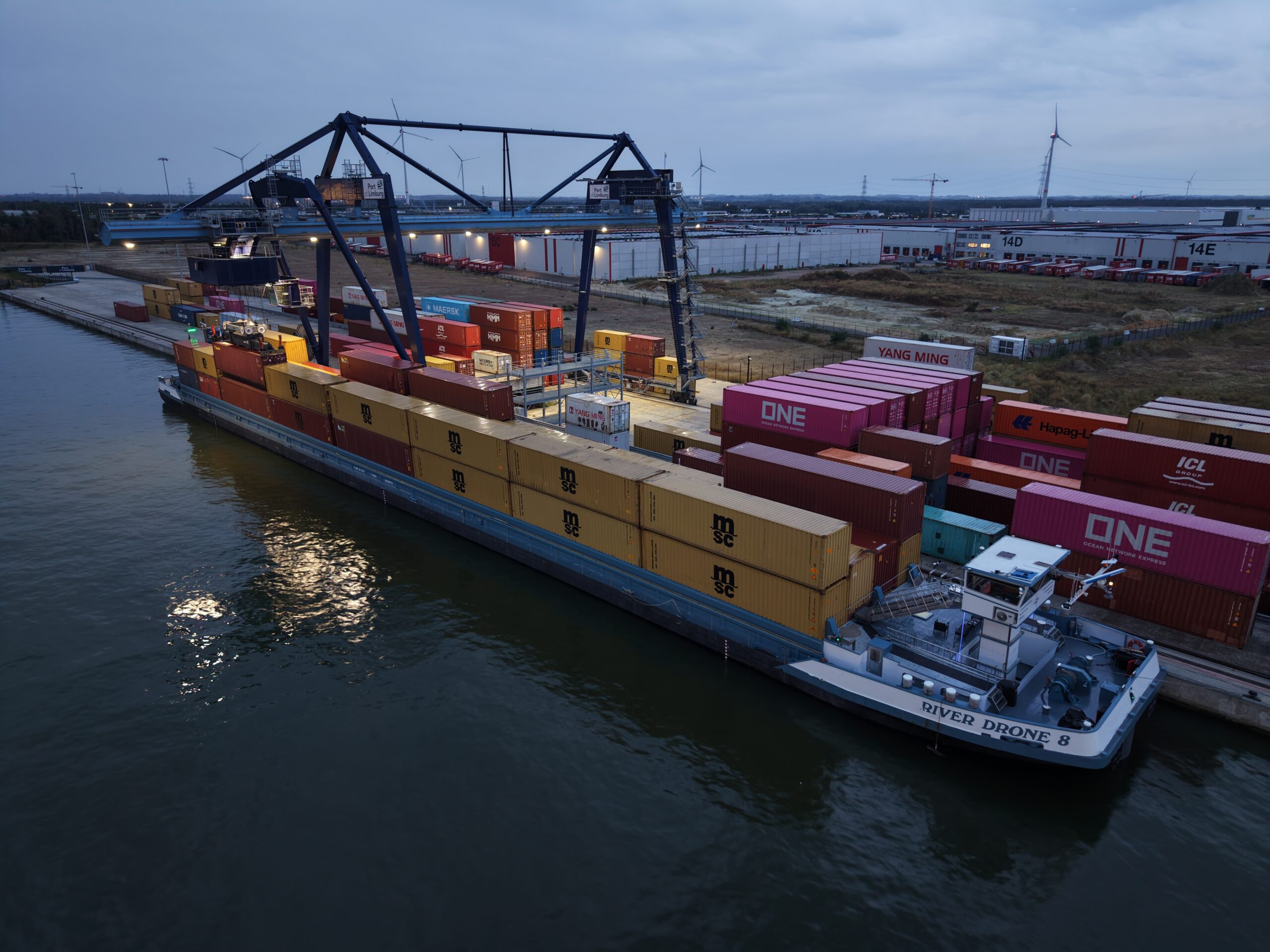
The Limburg–Antwerp Express: Port of Limburg and Gosselin join forces on the Albert Canal
Genk, 8 September – Last week, Port of Limburg successfully operated a container vessel carrying four layers of containers along the entire waterway between Genk and Antwerp. The test marks an important step in exploring the further potential of container transport by inland waterway on the Albert Canal.
A four-layer container configuration had previously been tested on a very limited scale, but never before along the full route between Genk and Antwerp. The challenge is considerable: the vessel must maintain sufficient clearance to safely pass under all bridges, while also respecting the maximum permitted draught in the canal.
Calculating down to the centimetre
Since the bridges over the Albert Canal were raised, more clearance has become available for higher container vessels. This additional space creates new opportunities, but it also requires careful preparation.
For the test, several factors were therefore taken into account, including the vessel’s loading, draught, available clearance under the bridges and the required ballast. Every centimetre counts when containers are stacked four layers high.
The test produced a positive result. The vessel sailed the full Genk–Antwerp route carrying 192 TEU stacked four layers high. A clearance of 0.5 metres under each bridge and 0.5 metres of draught margin in the canal was maintained, without the vessel requiring any additional ballast.
A next step for inland waterway transport
With this test, Port of Limburg aims to demonstrate the opportunities that arise when infrastructure, logistics and operational expertise come together.
“The raising of the bridges along the Albert Canal creates new opportunities. But opportunities only become valuable when you are willing to test them in practice,” says Benjamin Hermans. “With this voyage, we investigated what is operationally possible today along the full route between Genk and Antwerp. This provides valuable insights for the further development of container transport by inland waterway.”
The test was deliberately carried out without extensive prior announcement. The priority was first to validate the calculations and practical feasibility under real-world conditions. The successful test demonstrates the potential to further increase the capacity of container transport by inland waterway and to move more goods efficiently by water.
Port of Limburg remains committed to innovation and to making the most of the opportunities offered by inland waterway infrastructure.